


He becomes richer by adding the finer qualities of both Lakshmi and Saraswathi to himself. His bad qualities have been subtracted from him by the kind look of Shiva. Since his good qualities have increased, admirations from others have multiplied for him. He divides the hearts of scholars and keeps them with him; all these scholars appreciate him.
These are the achievements of a good-hearted person who churned the ocean of mathematics and excels among scholars. This is a verse by the author in praise of Mathematics and Mathematicians.
Since Mathematics is none other than logic, wherever and whenever mathematical sciences advance, the growth of physical sciences follows. This is a fact established by history. In order to assess the state of scientific development of any country at a given time, it may generally be adequate to study the state of mathematics of that time. From that, we can infer the state of other sciences.
Just as Mathematics is for physical sciences, so is logic for philosophical knowledge. Wherever logic develops, mathematics too flourishes there. In fact, there is only one difference between mathematics and logic. Logic is expressed in the local language, whereas mathematics is expressed in numbers and lines.
Ancient Indians, who had a spectrum of sciences to their credit, valued mathematics with the same reverence. Here is evidence from a work called Vedanga Jyotisha, which belongs to a period older than 1200 B.C.
Just as the natural feather on the head of a peacock and just as gems on the head of a divine serpent, Jyotisha—the science of astronomy—is placed on the head of the other Sastras.
So says the well-known Vedanga Jyotisha.
Time, Astronomy and Mathematics
In the Bhagavad Gita, the Lord says:
The meaning is given by Sri Sankaracharya. कलनं संकलनं व्य्वकलनं are the basic forms of गणनं संकलनं.
संकलनं means addition, while व्य्वकलनं means subtraction. Simplified addition is multiplication and simplified subtraction is division. Whatever may be the extent of development, mathematics can never go beyond these four operations; to be more precise, beyond these two operations. Hence, we can easily infer that Kaala and Ganita are not different from each other. Jyotisha is the science of Kaala. Hence, Jyotisha and Ganita cannot be different.
Therefore: Time = Astronomy = Mathematics
But one question may arise. Time is represented by numbers, whereas Jyotisha deals with geometrical figures. Then how can these two be equal? When these two are not equal, how can we say:
Time = Astronomy = Mathematics?
The question may be correct only to some extent. Astronomy is the science of time, and some may not like to say that Time = Astronomy. Even then, they cannot deny the underlying relationship.
This is because mathematics is a science in which there are two important and inseparable branches:
- Mathematics of Numbers
- Mathematics of Space
The mathematics of time deals with numbers, while the mathematics of space deals with lines, whether straight or curved. Since time and space are inseparable, these two branches of mathematics cannot be separated. Since the most ancient and the most modern concepts accept that, ultimately, time and space are not different, these two branches of mathematics also cannot be different in the ultimate sense. The “ultimate” is thoroughly discussed in the Vedas from different angles. Hence, the Veda had to deal with numbers, space and the mathematics which embodies both of them.
The Vedic Number System
Stray numbers can be used and utilized even by primitive societies, but numbers as a system can be utilized only by a developed society. History shows that, in any period of time, where numbers are used in a more systematic way, the better is the civilization of that society as a whole. Even though we are not exactly sure of what a Vedic period is, whatever it may be, we can estimate its civilization based on the number systems available in the Vedas.
Pythagoras, the celebrated philosopher and mathematician of 3rd century B.C., tried to evolve a numbering system to count the particles of sand in a given jar of sand and wrote his thesis, “The Calculus of Sand.” But, unfortunately, he could not develop a perfect decimal system of numbers because he could not think of “Zero” at that time.
Thousands of years before that, however, we find a full-fledged decimal system of numbers in the Vedic mantras. This gives values from 100 to 1012. Please note that the value of 100 is given as “1” in the sequence. This is not a rare or strange reference from the Veda. There is a passage addressed to Lord Agni:
“Oh Lord Agni! Prostrations to you once, twice, thrice, four times, five times, ten times, hundred times, up to thousand times and unlimited number of times.”
Here we find a definite pattern of progression of numbers. In the well-known Chamakadhyaya of Krishna Yajurveda, the mantra gives two sequences of numbers.
- First Sequence: 1, 3, 5, 7, 9, 11, 13, 15, 17, 19, 21, 23, 25, 27, 29, 31
- Second Sequence: 4, 8, 12, 16, 20, 24, 28, 32, 36, 40, 44, 48
The first one is a sequence of odd numbers from 1 to 31. The second one is not a sequence of simple even numbers. We can observe that these sequences follow the formula:

where x is a member of the first sequence and y is a member of the second sequence.
For example:
1 + 3 = 4
3 + 5 = 8
and so on up to the 12th place.
Thus, we find an intricate and systematic use of numbers in the Vedas. Added to this, perfect descriptions of cosmological events are found in the Vedas. The famous Nakshatreti Prakarana of Yajurveda and the cosmological details given in the Rigveda are more than enough to demonstrate this. As we entered the post-Vedic ancient literature, there are four important places where we find extensive use of mathematical formulas:
- The Sulba Sutras
- Vedanga Jyotisha
- Chandas Sastra
- Tantra
These are among the six auxiliaries to the Veda, as the wise ones say.
The Four Sources of Vedic Mathematics
Of these:
- The Sulba Sutras are an integral part of Kalpa.
- Vedanga Jyotisha is the essence of Jyotisha, the science of time and the science of cosmological bodies.
- Chandas is the science of metres of letters.
- Tantra is a science and art which tries to simplify Vedic rituals for the benefit of the less privileged beings.
Each of these four subjects uses mathematics in a different manner.
- Sulba Sutras use mathematics in the context of construction of different types of structures.
- Jyotisha uses mathematics at every step.
- Chandas uses mathematics when it deals with the permutations and combinations of metres.
- Tantra uses mathematics when it translates divine energies into geometrical figures called Yantras.
So, to understand Vedic Mathematics, we have to study all the four subjects referred to above. Studying them directly is not a simple thing because they are not direct textbooks of mathematics. Nevertheless, a great deal of mathematics is used in them. To make mathematics simpler and easier to understand, later scholars started dividing mathematics into several sub-branches.
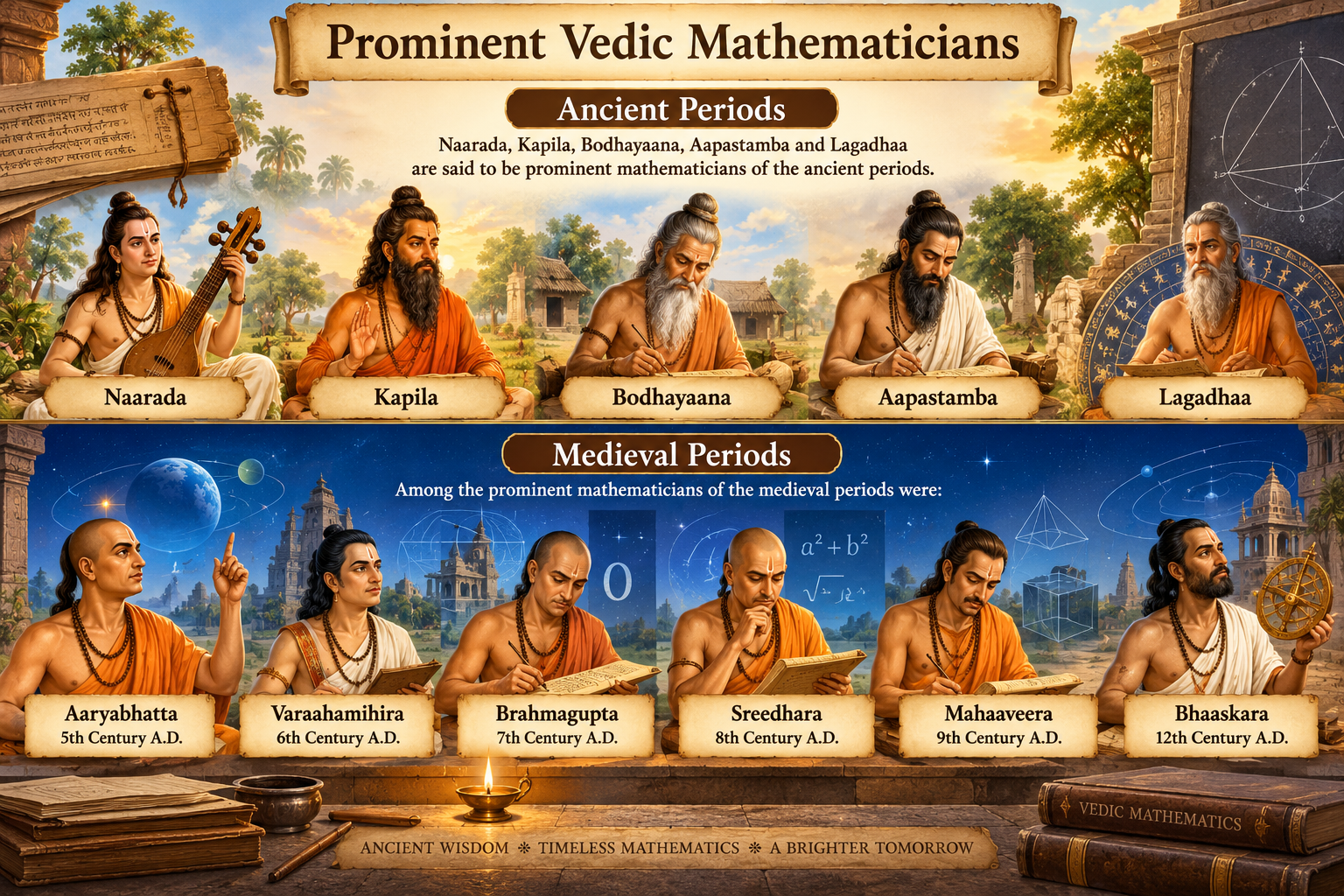
Prominent Vedic Mathematicians
Naarada, Kapila, Bodhayaana, Aapastamba and Lagadhaa are said to be prominent mathematicians of the ancient periods.
Among the prominent mathematicians of the medieval periods were:
- Aaryabhatta — 5th Century A.D.
- Varaahamihira — 6th Century A.D.
- Brahmagupta — 7th Century A.D.
- Sreedhara — 8th Century A.D.
- Mahaaveera — 9th Century A.D.
- Bhaaskara — 12th Century A.D.
These masters developed wonderful methods of teaching mathematics to youngsters. But, in the process of doing so, it seems that they deviated from the age-old Vedic techniques that were prevalent during the ancient periods. In the recent past, Jagadguru Bhaarati Krishna Teertha of Dwaraka Sankaraachaarya Peetha revived 16 fundamental Vedic statements of mathematics and demonstrated how these 16 formulas could be used for almost all branches of mathematics.
His writings were published under the title “Vedic Mathematics” in 1965 for the first time. The methods presented in Vedic Mathematics attracted considerable attention because of their simplicity and the different approach they offered compared with the mathematics commonly described as advanced Western mathematics. Hence, Bhaarati Krishna Teertha’s Vedic Mathematics has acquired increasing importance internationally. Before actually entering the area of Vedic Mathematics, it is useful to understand at least a little of the theory behind Vedic Mathematics.
The Theory Behind Vedic Mathematics
According to the Vedic concept, there is no fundamental difference between a number and a line. Every number is represented by a line in space, and every line in space is represented by a system of numbers, called equations. For example, the number one (1) is represented by a straight line segment of unit length.
- 1 + 1 is represented by a similar line of two units.
- 1 − 1 is represented by a line of no units, i.e. a single point or Bindu.
Thus, 1, 1 + 1 and 1 − 1 represent segments of a single dimension in a plane. Of course, a Bindu can be a part of any plane or dimension.
Now consider: 1 × 1 = 1 > This one cannot be represented by a straight line. Only a square of one unit length on all sides can represent this number “One”. Similarly:1 ÷ 1 = 1. But the above square cannot represent it. It is represented by a straight line of one unit. However: 1 × 1 × 1 = 1 > is represented by a cube of unit 1. This means that as we go on multiplying numbers, our dimensions in space also go on multiplying.
Since we agree to accept only three dimensions in space, we agree to ignore a greater number of dimensions as far as mathematics is considered.
Now consider: −1 × (−1) = +1, Can this be represented by a square of one unit, as mentioned earlier? The answer is not so simple. 1 × 1 and −1 × −1 may be equal number-wise, but space-wise they are only similar, not identical. For the same reason, the square root of √1 cannot be a single value. It should give rise to two values:
- One corresponding to the x, y-axis, or the first quadrant.
- The other corresponding to the x, −y-axis, or the fourth quadrant.
Similarly, ∛1, the cube root of one, yields three values corresponding to the x, y, z axes. They are:
- 1 × 1 × 1
- −1 × (−1) × 1
- 1 × (−1) × (−1)
The Circle and the Line
Now think of a circle. A circle is a line which satisfies the equation: ox = r, where o is the centre of the circle and r is a constant. Suppose: r = 1, Then, can there be a different circle for: r = −1? No. Hence, we agree to say that r can never be negative. That is why Vedic mathematicians said that a line is more perfect than a number.
The sutra given by Sri Kalyaanaananda Bhaarati, a great exponent of Tantrik mathematics, expresses this idea. As compared to the word “one”, the representative letter “x” is better; compared to this, the symbol “1” is better; and compared to this, the line on the “ox” axis is better. Thus, the Vedic seers saw mathematics simultaneously from both the angles of number and space. Because of this, they could evolve very simple mathematical procedures.
As explained earlier, one of the branches of mathematics, Kshetra Ganita, is further classified as:
- Jyamiti
- Trikonamiti
- Graha or Gola Ganita
Basically, What Are Sulba Sutras?
The Sulba Sutras are not textbooks of mathematics or geometry. They are texts which describe different types of Yagnas, Yagas and the procedures related to them. In that context, they had to provide instructions for constructing altars, Yagna Vedis and Yagna Saalaas, of different shapes. For this purpose, they had to refer to some mathematical formulas that were popular in those days. The instructions were given to a common, uneducated worker who was engaged in constructing the Vedis. Hence, the Sulba Sutras took care to ensure that no unnecessary complications entered their explanations or procedures.
The word “Sulba” means a thread or a rope.
The entire procedure of constructing rectangular, square, triangular, circular, semicircular and other shapes of the Yagna Kundas, by sages such as Apastamba, Bodhayana and Satyaashaada, took the aid of only two things:
- Sulba — a thread
- Scale
That is all. There were no meters to verify right angles, no compass to draw circles, and no angulometer to measure angles. Yet, they could describe complicated procedures such as constructing a square or rectangle of a given area and then constructing a circle or semicircle of the same area. All these things could be accomplished with the help of only a thread and a scale. In addition to this, the Sulba tradition took the opportunity to describe values of π, √2, 3, and other mathematical quantities.
Now, we shall have a few glimpses of those astonishing ancient Sulba Sutras, in the next Article: Glimpse of Vedic Geometry: Prof. K. V. Krishna Murthy on Vedic Mathematics, Numbers, Space and the Sulba Sutras | 102