

With the Continuation from the previous article On: Glimpse of Vedic Geometry: Prof. K. V. Krishna Murthy on Vedic Mathematics, Numbers, Space and the Sulba Sutras | 101. The real beauty of the Sulba Sutras becomes evident when we examine the geometrical constructions described in them. The purpose was not mathematics for mathematics’ sake. Geometry was used as a practical means of constructing sacrificial altars according to prescribed shapes, dimensions and areas.
- The Diagonal of a Rectangle
- Constructing a Square Equal to Two Squares
- Constructing a Square Equal to a Given Rectangle
- Transformation of Squares and Circles
- Values of π in the Sulba Tradition
- The Remarkable Approximation of √2
- Doubling the Area of a Square
- Division of a Line
- Geometry Through the Rope
- Geometry and Practical Knowledge
- Conclusion
The altar could take different forms, and the dimensions had to be carefully maintained. The construction therefore required a practical knowledge of lines, lengths, areas, squares, rectangles, diagonals and circles. The rope, or Sulba, was the principal measuring instrument. With a rope and simple measurements, the required geometrical forms could be laid out on the ground.
The Diagonal of a Rectangle
One of the remarkable geometrical principles found in the Sulba Sutras concerns the diagonal of a rectangle. The rule can be expressed in modern mathematical language as: a² = b² + c². In other words, the square on the diagonal of a rectangle is equal to the combined squares on its length and breadth. The Sulba tradition expressed this geometrical relationship through the practical use of a stretched rope. The diagonal was not merely a theoretical line; it was something that could actually be constructed and measured during altar construction. This principle is also associated with several examples of right-angled triangles and what are now called Pythagorean triples, including:
- 5, 12, 13
- 8, 15, 17
- 12, 16, 20
- 12, 35, 37
Thus, geometrical relationships could be expressed through whole-number measurements suitable for practical construction.
Constructing a Square Equal to Two Squares
The Sulba Sutras also describe methods for constructing a square whose area is equal to the combined areas of two given squares. Suppose two squares have different areas. A suitable line can be constructed from the sides of the two squares, and the resulting diagonal provides the side of a new square. The geometrical principle is straightforward:
Area of new square = Area of first square + Area of second square
This is another practical application of the relationship between the sides and diagonal of a right-angled triangle. The construction demonstrates an important idea: areas can be transformed from one geometrical form into another while preserving their total value.
Constructing a Square Equal to a Given Rectangle
Another interesting problem is the construction of a square equal in area to a given rectangle. A rectangle may have a particular length and breadth, but the requirement may be to construct a square having exactly the same area. The Sulba procedure provides a geometrical construction for accomplishing this transformation. The rectangle is divided and rearranged through a sequence of constructions until a square of equal area is obtained. This is significant becau
se it shows that the geometrical tradition was concerned not merely with drawing shapes, but with transforming one area into another equivalent area. The construction could therefore be used whenever an altar or other required figure had to be changed from one shape into another without changing its prescribed area.
Transformation of Squares and Circles
The Sulba Sutras also deal with the difficult problem of transforming a square into a circle of approximately equal area and, conversely, constructing a circle corresponding to a given square. These constructions are especially interesting because they involve the value of π.
The procedures do not always produce an exact equality in the modern mathematical sense. They are geometrical approximations intended to achieve the required practical result. Different Sulba texts contain different approximations for π. This reflects the practical nature of the constructions: the geometrical procedure itself was important, and the numerical value of π was implicit in the resulting construction.
Values of π in the Sulba Tradition
Several approximations for π are associated with the Sulba Sutras. For example, constructions in the Baudhayana Sulbasutra correspond to values such as: π ≈ 676/225 = 3.00444…
Other constructions correspond to different approximations, including: π ≈ 900/289 and π ≈ 1156/361. The presence of several approximations is understandable when the geometrical objective is to construct equivalent areas using practical procedures. The important point is that the Sulba tradition connected the measurement of circles with the transformation of geometrical areas.
The Remarkable Approximation of √2
One of the most celebrated mathematical results associated with the Sulba Sutras is the approximation of the square root of 2. The value is expressed as:
√2 = 1 + 1/3 + 1/(3 × 4) − 1/(3 × 4 × 34)
This gives: √2 ≈ 1.414215686…
which is correct to five decimal places. In fractional form, the approximation is: √2 ≈ 577/408
The appearance of this value is closely connected with geometrical construction. When a square is transformed into another square having twice the area, the side of the resulting square is related to √2. Thus, the requirement of constructing an altar of twice the area of another altar naturally leads to the geometrical problem of finding the side of a square whose area is doubled. The mathematical quantity √2 therefore arises directly from a practical geometrical problem.
Doubling the Area of a Square
Consider a square having a particular area. If a second square is required to have twice that area, its side cannot simply be doubled. Doubling the side would produce four times the original area. Instead, the new side must be: √2 × the original side. This is a beautiful example of how a geometrical construction leads naturally to an irrational quantity. The Sulba tradition therefore connects: Square → Area → Diagonal → √2.
The relationship between these ideas illustrates the practical origin of important mathematical quantities.
Division of a Line
The Sulba tradition also contains constructions involving the division of a line into equal parts. Such constructions were important because altar designs required accurately measured lengths and proportions. The ability to divide a line into prescribed parts using geometrical methods demonstrates the practical importance of proportional reasoning and measurement. These were not abstract exercises detached from daily activity. They were part of the procedures required for constructing precise ritual structures.
Geometry Through the Rope
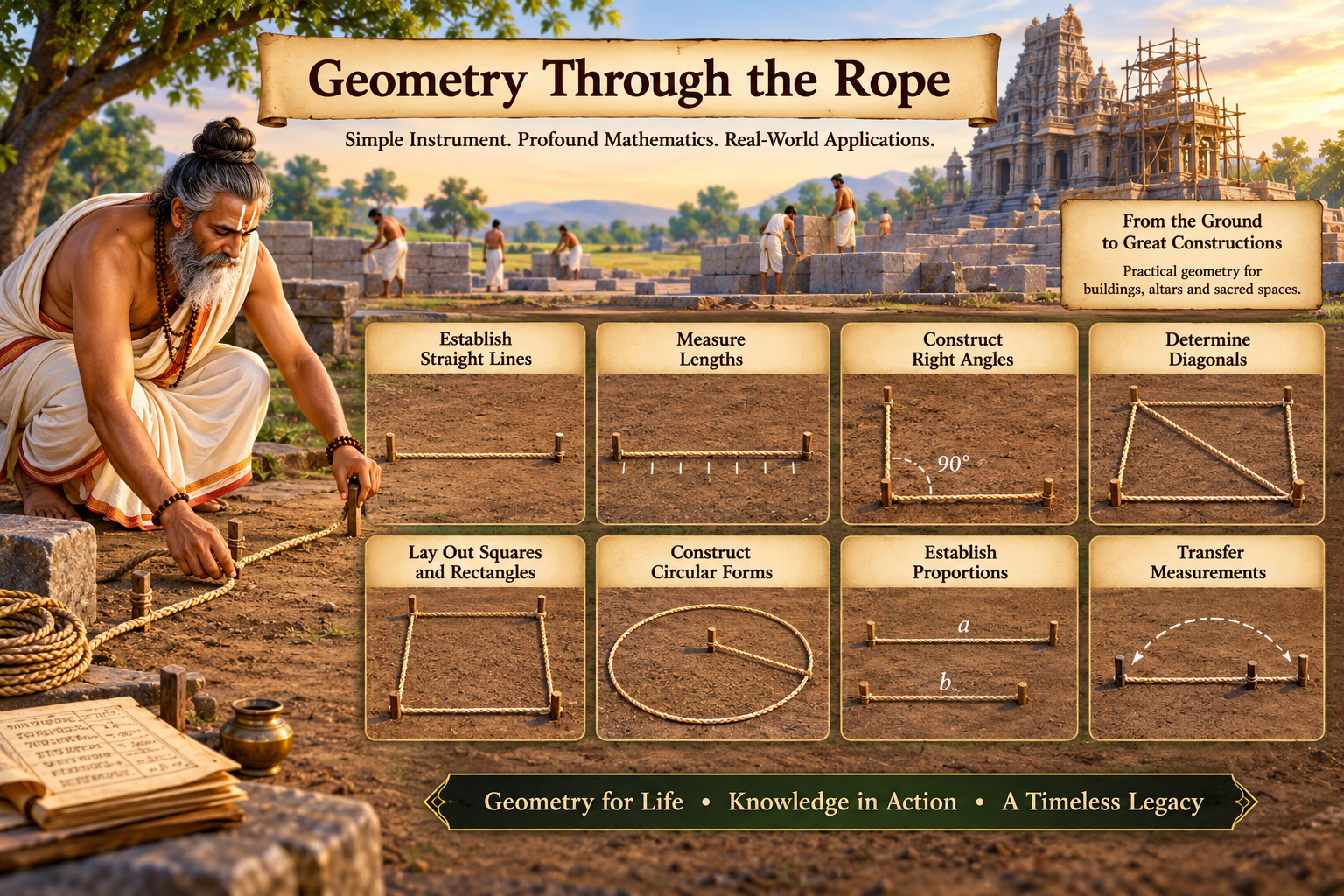
The most striking feature of the Sulba Sutras is the simplicity of the instruments. The fundamental instrument was the rope. With a rope, it was possible to:
- establish straight lines,
- measure lengths,
- construct right angles,
- determine diagonals,
- lay out squares and rectangles,
- construct circular forms,
- establish proportions,
- and transfer measurements from one part of a construction to another.
The rope transformed geometrical principles into practical construction methods. The geometry was therefore not merely written on a page. It could be drawn on the ground, measured and physically constructed.
Geometry and Practical Knowledge
The Sulba Sutras demonstrate an important characteristic of ancient mathematical knowledge: mathematical ideas often developed in response to practical requirements. The construction of an altar required knowledge of:
Length → Area → Shape → Proportion → Measurement → Transformation
A change in shape could not be made arbitrarily. If the prescribed area had to remain unchanged, a geometrical method was necessary. Similarly, if an altar had to be enlarged while preserving its shape, the corresponding measurements had to be calculated carefully. This created a practical environment in which geometry and numerical reasoning worked together.
The Sulba Sutras should therefore not be viewed merely as collections of ritual instructions. They preserve a body of geometrical knowledge expressed through practical construction. The traditions associated with Baudhayana, Apastamba, Manava and Katyayana contain rules dealing with squares, rectangles, triangles, circles, diagonals, areas, proportions and geometrical transformations. Their methods show how mathematical reasoning could be incorporated into the construction of complex structures using very simple tools. The remarkable feature is the combination of simplicity of instruments and sophistication of geometrical ideas.
From Number to Space: The discussion of the Sulba Sutras brings us back to the central idea of Vedic Geometry: the relationship between number and space.
- A number can describe a length.
- Lengths can form a shape.
- Shapes possess areas.
- Areas can be transformed.
- And transformations lead to mathematical relationships.
Thus: Number → Line → Shape → Area → Geometry
This provides a natural connection between the mathematics of numbers and the mathematics of space. The same relationship lies behind the earlier discussion of Kshetra Ganita, where mathematical quantities are understood through geometrical forms. The mathematical ideas associated with the Vedic tradition encompass much more than numerical calculation.
They include:
- numerical sequences,
- measurement,
- astronomy,
- geometrical construction,
- areas and dimensions,
- proportions,
- permutations and combinations,
- geometrical transformations,
- approximation,
- and the relationship between numbers and spatial forms.
The Sulba Sutras represent one of the clearest examples of mathematics being applied directly to construction. Their use of the rope as a measuring and constructing instrument is especially significant. A simple thread could become a practical geometrical tool through mathematical reasoning.
Conclusion
The journey from numbers to lines, from lines to shapes, and from shapes to measurable areas reveals the close relationship between mathematics and geometry in the ancient Indian tradition. The Vedic mathematical tradition connects Ganita, Jyotisha, Kshetra Ganita and the Sulba Sutras through a common concern with number, measurement, space and order. The Sulba Sutras demonstrate how mathematical principles could be transformed into practical constructions. Squares could be combined, rectangles could be transformed into squares, circles could be constructed to correspond approximately to given areas, diagonals could establish right-angled relationships, and the geometry of area could lead to remarkable approximations such as √2.
What makes these traditions particularly fascinating is that sophisticated geometrical ideas were expressed through remarkably simple practical instruments—principally a rope and a scale. The study of these ancient constructions therefore gives us more than a collection of mathematical rules. It provides a glimpse into a tradition in which mathematics was observed, reasoned, measured and constructed in space.
The Sulba Sutras stand as an important part of that mathematical heritage, preserving a remarkable connection between ritual construction, geometry, measurement and mathematical thought. These glimpses offer only an introduction to the extraordinary geometrical knowledge contained in the Sulba tradition. The detailed constructions, measurements and mathematical procedures provide a fascinating field for further study and a deeper appreciation of the development of geometry in ancient India.